
The Neural Factory: Why High-Mix Manufacturing Must Move Beyond Caged Robots to Edge-Driven Intelligence
Madhu Gaganam
4/12/20264 min read
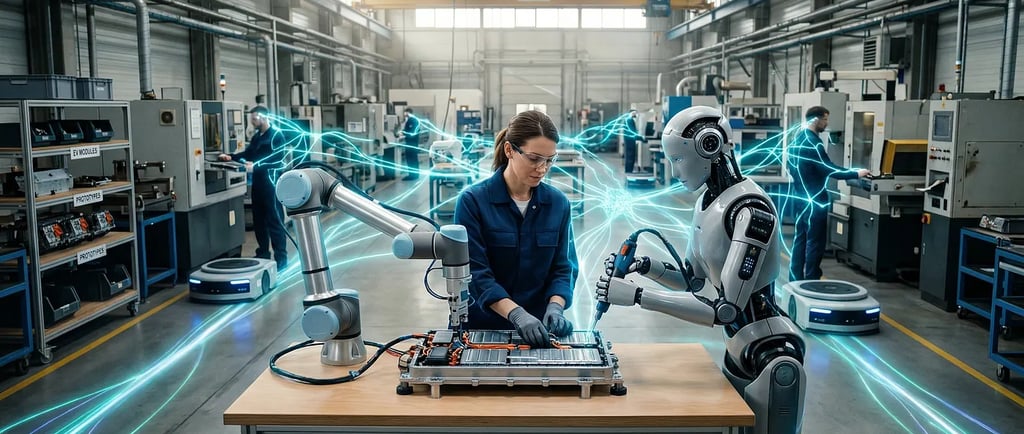
Walk onto the floor of a modern high-mix manufacturing plant, whether assembling custom EV battery modules, finishing intricate aerospace components, or building precision electronics at companies like Jabil or Boeing, and you will see humans and machines attempting to share the exact same workspace. At CogniEdge.AI, we work closely with plant leaders who are investing millions in automation yet still battling the same daily frustrations. We believe the solution isn’t simply more robots. It is smarter, more adaptive intelligence that truly partners with their teams.
We are in the midst of a profound transformation, moving away from rigid, purpose-built automation toward the integration of collaborative robots (cobots), robotic arms, and soon, fully autonomous humanoids. Yet, despite billions invested in industrial automation, many factory teams still experience the same daily frustrations: unexpected stops, rigid pacing that ignores worker fatigue, and systems that feel like stubborn obstacles rather than true partners.
To unlock the true potential of human-robot collaboration, we must fundamentally confront the current challenges of high-mix assembly, the emerging bottlenecks of Physical AI, and the absolute necessity of transitioning to a decentralized “Neural Factory.”
The Current Challenge: The Brownfield Reality and the “Caged” Model
For decades, the standard for safety and efficiency in the industrial sector has been defined by distance and exclusion zones. In this “caged” model, the robot was a high-speed, high-precision tool, and the human was a supervisor kept strictly on the periphery.
However, this model breaks down in high-mix manufacturing. Exploding product variants, sudden layout changes, and fluctuating human energy levels demand adaptability. Furthermore, the vast majority of global factories are decades-old “brownfield” sites characterized by narrow aisles, poor wireless connectivity, and high digital noise. When a traditional, script-driven robot encounters an exception in these messy environments, such as a blocked aisle or a new custom variant, it cannot adapt. It triggers an emergency stop, requiring manual reprogramming and causing massive production downtime.
The Future Challenge: The Latency Wall and Vigilance Fatigue
As the industry attempts to solve these issues by introducing Physical AI and autonomous humanoids, we are running into critical new roadblocks.
The Latency-Cognition Gap (The 800 ms Catastrophe): The original “Smart Factory” vision assumed all sensor data would be pushed to the cloud for heavy AI processing and sent back as commands. But in the physical world, where a robotic arm moves at 1.5 meters per second, an 800-millisecond cloud-processing delay means the machine travels nearly 4 feet completely blind before braking. In a shared workspace, this latency is a catastrophic safety failure waiting to happen.
Vigilance Fatigue: As machines make autonomous decisions, the human brain is pushed into a state of constant, high-stakes prediction, silently monitoring the robot’s every twitch and trajectory. This continuous mental scanning creates a heavy cognitive load known as “Vigilance Fatigue,” which drains human energy, causes burnout, and leads to preventable errors.
The CapEx Trap: The Silicon Valley narrative often assumes a “rip-and-replace” approach, requiring legacy factories to be gutted for pristine robotic ecosystems. For most mid-market and large manufacturers, the capital expenditure (CapEx) to replace decades of existing infrastructure is a financial non-starter.
The Paradigm Shift: Enter the Neural Factory
To survive and scale, manufacturing cannot rely on centralized cloud brains or rigid programming. We must mimic biological evolution. The future of Industry 5.0 is the Neural Factory, a framework that operationalizes distributed intelligence by creating a decentralized “nervous system” for the factory floor.
That’s why, at Cogniedge.AI, we developed the Cohesive Edge-Driven Robotics (CEDR) framework. This framework transforms standard hardware into intelligent, autonomous nodes across four integrated dimensions:
Edge-Native Reflexes
Just as a human hand pulls away from a hot stove before the signal reaches the brain, robots need a localized “reflex arc.” By utilizing neuromorphic computing and processing data locally at the edge, robots achieve sub-30 millisecond reflex latencies. The robot halts instantly if a human slips into its path, not because the cloud commanded it, but because its local “spinal cord” reacted.
Neuroadaptive Human-Robot Collaboration (HRC)
The Neural Factory does not treat humans as obstacles; it treats them as biological teammates. Using wearable sensors (such as industrial-grade smartbands tracking motion and vitals) and our patent-pending Human State Vector (HSV) engine, the system tracks physiological and cognitive states in real time. If a worker shows signs of spiking stress or fatigue, the fleet doesn’t just keep going. It proactively adapts. This isn’t about replacing humans; it is about protecting the one irreplaceable asset on the floor: the human.
Shifting from Operators to Orchestrators
In the Neural Factory, humans no longer write explicit spatial paths or babysit override buttons. Humans step into the role of strategic orchestrators. The human defines the intent, the “what” and the “why,” while the decentralized swarm of robots and humanoids executes the hyper-precise physical “how.”
Bridging the Brownfield Divide
Most importantly, the Neural Factory overlay is hardware-agnostic. It is designed to interface with 30-year-old legacy PLCs and brand-new autonomous vehicles alike. This allows manufacturers to achieve the high-margin ROI of human-robot collaboration without the paralyzing CapEx of a complete facility overhaul.
As an early pre-seed company, we are still in the very early innings of this transition. We have successfully completed our initial Proof of Concept with the CEDR framework and are now developing our critical MVP, with pilots planned in the coming months. These early results already give us strong confidence that manufacturers will unlock high-margin ROI without the paralyzing CapEx of a full rip-and-replace.
The Bottom Line
"The transition to Physical AI is not about building dark, empty factories. The highest economic value will come from fusing human cognitive flexibility with robotic precision."
At CogniEdge.AI, we are betting everything on helping manufacturers make this shift the right way. By deploying the Neural Factory concept and the CEDR framework, forward-looking manufacturing companies can create systems where machine precision and human intuition operate in a seamless, borderless loop. The factory of the future won’t be empty. It will be more resilient, more productive, and more human than ever.
We are still learning alongside our manufacturing partners. If you are wrestling with these same challenges on your floor, I would love to compare notes.