
White Papers


The Orchestration Economy: Navigating the Transition from Manual Labor to Physical AI
The industrial narrative is frequently trapped in a false dichotomy: will physical artificial intelligence entirely eradicate human labor, or will it remain permanently tethered as a subservient collaborative tool? As the global economy pivots from digital, cloud-based models to physical, embodied AI, stakeholders must recognize that "Replacement" and "Collaboration" are not opposing futures.
Rather, they are sequential phases dictated by the complexity of the physical environment. This paper dismantles the economic paradoxes governing this transition, mapping the trajectory from localized, edge-driven human-robot collaboration to autonomous environmental orchestration. By confronting the pragmatic friction points of hardware deployment, shared liability, and cognitive privacy, this document outlines critical strategic imperatives for policymakers, technology leaders, and capital allocators.
Ultimately, the future of industry belongs neither strictly to the autonomous machine nor to the manual human laborer, but to the seamless, low-latency synthesis of both.
Download the white paper here.
The Smart Factory vision of the last decade has hit a physics wall.
As the global push to reshore manufacturing accelerates, we are discovering the limits of centralized computing. The Cloud remains powerful for high level data analytics, but relying on it for the split second safety reflexes of industrial robots is simply too slow. When metal dense facilities create digital dead zones, industrial survival depends on local physics, not distant bandwidth.
For our investor and partner network, this document outlines the exact blueprint for unlocking the largest untapped segment of the 124 billion dollar robotics market. By deploying Cohesive Edge Driven Robotics (CEDR), we can turn existing legacy machines into a decentralized and intelligent swarm.
Download the white paper here.


The Neural Factory: Organizing Distributed Intelligence for Industry 5.0
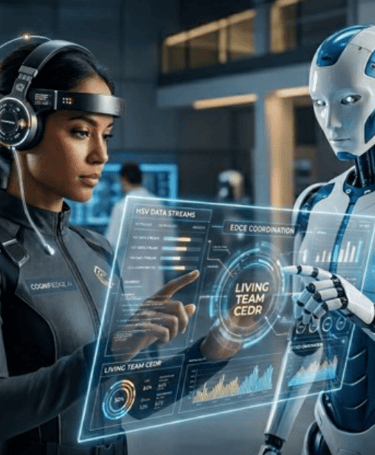

The Adaptive Factory: Future-Proofing High-Mix Manufacturing with CEDR Framework
Rigid, scripted robotics fail in high-mix manufacturing because they cannot perceive or adapt to the human worker's changing cognitive state. By integrating neuro-sensing and edge-native AI, the CEDR framework enables robots to adjust their speed and tasks in real-time based on worker fatigue or stress, creating a "living team" dynamic.
This whitepaper serves as the strategic foundation for CogniEdge’s CEDR platform, detailing how the patented technology bridges the gap between digital reasoning and physical reflexes.
The framework offers a scalable "Robotics-as-a-Service" (RaaS) opportunity that maximizes existing brownfield assets while targeting a 25% increase in operational throughput and significantly reduced defect rates.
Download the whitepaper here.
Physical AI: Practical Intelligence for Industry 5.0
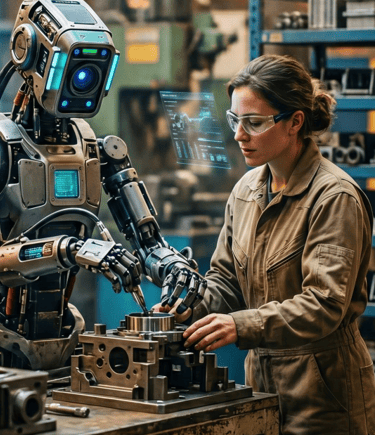
The global Physical AI market is growing at a CAGR of 33.49%. This expansion is driven by demand in manufacturing, logistics, healthcare, and beyond. Record investment activity underscores this shift, with robotics VC funding hitting an alltime high of $40.7 billion in 2025 and the broader humanoid ecosystem projected to unlock trillions in value over the coming decades.
Yet, the true value will not come from hype or isolated pilots. It will come from practical, scalable deployment in the brownfield environments where most industrial operations exist today.
At Cogniedge, we believe the winners will be those who bridge the gap between visionary models and reliable, human centric operation in the messy real world.
This paper outlines why Physical AI is at an inflection point, the pragmatic challenges that remain, and how edge driven, human first architectures deliver a sustainable competitive advantage.
Download the whitepaper here.