The Future of the Human and Robot Collaborative Model
Madhu Gaganam
3/16/20263 min read
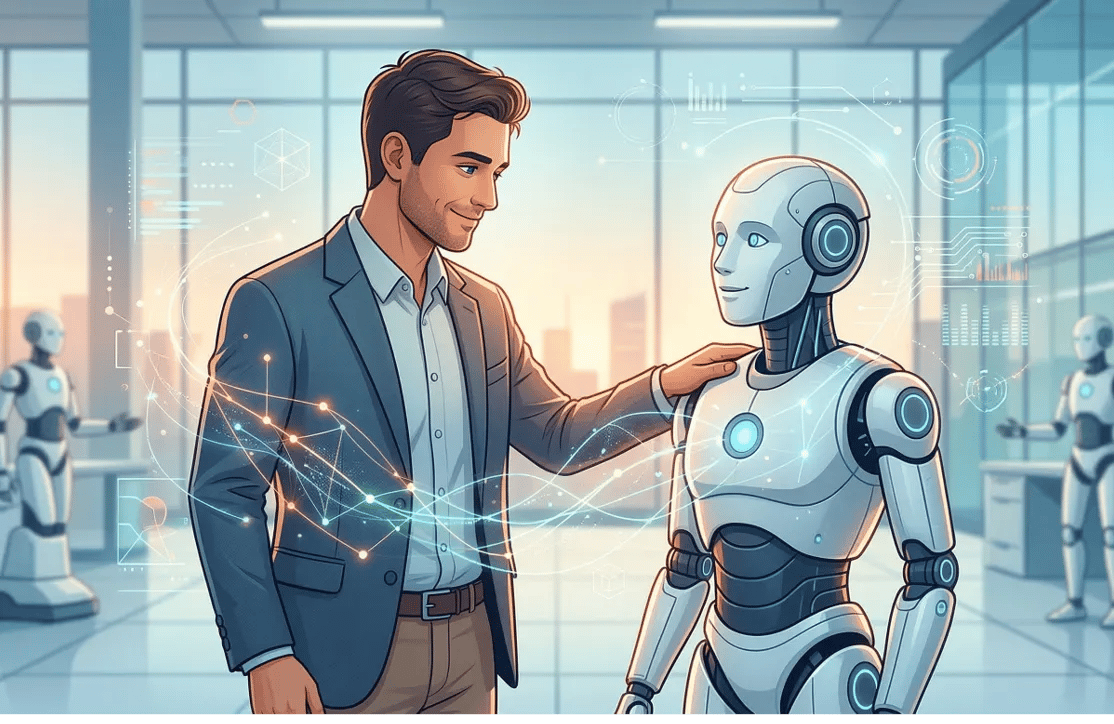
I was at a Physical AI event recently, and someone asked me a question that I have been thinking about a lot lately. What is the future of human and humanoid collaboration actually going to look like?
It is a fair question. After spending over three decades in the industrial sector, I have seen my share of technological hype cycles. For years, deploying robotics simply meant rigid programming. It involved coding specific spatial paths and relying on highly structured, predictable environments.
But as we stand at the intersection of neuroscience, artificial intelligence, and advanced manufacturing today, the dynamic is fundamentally changing. We are moving away from a model of rigid programming toward one of dynamic orchestration. In this new era of Physical AI, robots and humanoids are no longer just automated tools. They are neuroadaptive agents that physically execute human ingenuity in real time.
The collaborative model of the future is defined by a clear division of labor. Humans provide the intent and strategy, while machines handle the rigorous physical execution.
Here is what that architecture looks like in complex, dynamic environments.
1. The Human Role: The Architect of Intent and Strategy
No matter how advanced AI becomes, machines fundamentally lack human spatial intuition, contextual empathy, and the ability to seamlessly navigate unprecedented, chaotic breakdowns. Our role is shifting from manual operators to strategic orchestrators.
Defining the “What” and “Why”: We will no longer program pathing. We will program intent. Instead of coding a robotic arm to move 30 degrees to the left, the human operator defines the complex goal, such as reconfiguring this assembly line for a new prototype while minimizing material waste.
Handling Edge Cases and Unpredictability: When a system encounters a breakdown that historical data cannot solve, human intuition steps in to improvise a physical workaround. We remain the ultimate problem solvers for the nonalgorithmic realities of the physical world.
Dynamic Supervision via Digital Twins: Operators will monitor and guide highly complex, synchronized operations through high fidelity digital twins. This allows the human mind to intuitively grasp the big picture of a manufacturing floor and make strategic, macro level adjustments that instantly cascade down to the physical robotic fleet.
2. The Humanoid and Robotic Role: The Engine of Physical AI
If humans are the architects, advanced robotics and humanoids are the engines. They handle the hyper precise, physically demanding, and mathematically optimal execution of human intent.
Autonomous Translation of Intent: Powered by agentic AI, the humanoid takes a broad human goal and autonomously calculates the thousands of micro movements, force and torque adjustments, and spatial logistics required to achieve it safely and efficiently.
High Fidelity Execution and Endurance: The machine executes the task with millimeter precision. It operates in hazardous environments and handles payloads that exceed human limits, completely free from physical fatigue or operational drift.
Swarm and Agentic Coordination: While a human orchestrates the broader floor, the machines communicate with each other peer to peer. If one robot encounters an obstacle, the entire swarm dynamically recalculates its logistics instantly, without needing human intervention to solve the minor issue.
3. The Interface: Neuroadaptive and Edge Driven Collaboration
For this model to function seamlessly, especially in high stakes industrial environments, the interface between human and machine must evolve beyond simple dashboards or vocal commands. It requires deep, instantaneous integration.
Neuroadaptive Feedback Loops: The frontier of human and robot interaction involves neuroadaptive interfaces where the robotic system adjusts its physical behavior based on the human operator’s cognitive state. If a human worker is experiencing high cognitive load or fatigue while guiding a complex task, the robotic system senses this and autonomously slows its movements, expands its safety buffers, or prompts for confirmation, creating a deeply symbiotic working environment.
Instantaneous Edge Computing: This level of reactivity cannot rely on the latency of the cloud. To react to human unpredictability in real time, the data processing must happen at the edge. Edge computing guarantees that the machine can dynamically adapt its physical force and trajectory the exact millisecond a human unexpectedly enters its workspace, ensuring absolute safety and unbroken operational flow.
The Future is Orchestration
This model represents the ultimate evolution of industrial work. We are not being replaced by humanoids. Instead, our capabilities are being exponentially scaled by them.
Humans remain firmly in control of direction, meaning, and complex problem solving. Meanwhile, Physical AI and autonomous humanoids amplify our capacity to execute those ideas flawlessly. In the very near future, we will stop being robotic operators entirely, stepping fully into our new roles as orchestrators of physical intelligence.