From Safe Coexistence to True Partnership: Smarter Human-Robot Collaboration in Real Factories
Madhu gaganam
4/2/20266 min read
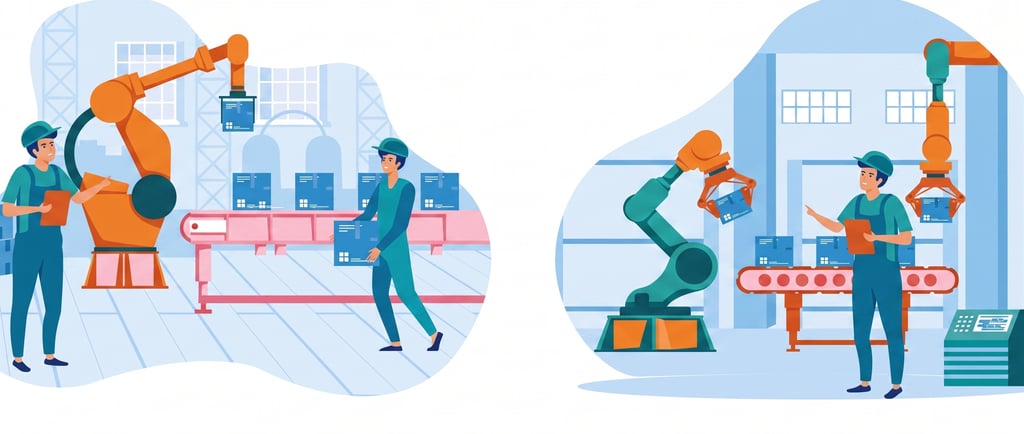
In today’s high-mix manufacturing environments—whether assembling EV battery modules, finishing aerospace components, or building precision electronics—robots and humans increasingly share the same workspace. Collaborative robots (cobots) promise to combine human judgment and flexibility with robotic strength and repeatability.
Yet, many factory teams still experience the same frustrations: unexpected stops, rigid pacing that ignores worker fatigue, and a lingering sense that the robot is simply “there” rather than truly working with the operator.
The shift from basic safe coexistence to genuine partnership is no longer a nice-to-have. It is becoming essential for Industry 5.0 goals of resilient, human-centric production. The good news? New supervisory approaches are emerging that deliver smarter safety, real-time adaptation, and higher trust—all without replacing existing robot controllers, safety PLCs, or certified infrastructure.
This article explores practical ways manufacturers can move toward more thoughtful human-robot teamwork using layered intelligence that respects brownfield realities.
Imagine a single workcell on an EV battery assembly line. A worker and a cobot jointly install busbars. The robot applies consistent force while the human ensures precise positioning on varying module designs. When the operator briefly steps back to grab a tool, or when a large component temporarily blocks the camera, a basic safety system might freeze the entire cell. Production halts. Frustration builds. Output drops.
A more advanced supervisory layer changes this dynamic. Instead of reacting only to presence or absence, it understands context: Was the worker’s movement intentional? Is fatigue starting to affect focus? Should the robot slow down slightly or adjust its path to maintain safe separation? These contextual decisions keep the line moving smoothly while protecting people.
Context-Aware Safety: Moving Beyond Simple Detection
Traditional safety in collaborative robotics relies heavily on sensors that detect human presence—cameras, LiDAR, or force-torque limits. These systems are essential, but they often lack a deeper understanding of the situation.
A smarter supervisory approach asks better questions:
Did the human leave the workspace intentionally, or has something unexpected occurred?
Is an object temporarily blocking the view, or is there a genuine safety concern?
How should the robot’s speed or force be adjusted based on the current task state and operator condition?
In practice, this means fewer false stops and more graceful responses. Consider an aerospace blade polishing cell. A large fixture momentarily obscures the operator from the vision system. A rigid setup triggers an emergency pause. A context-aware supervisor, however, cross-checks recent motion patterns and task progress, then gently reduces robot speed while maintaining a safe distance. Once the line of sight clears, normal operation resumes seamlessly.
This type of layered supervision can run in parallel with existing safety logic. It injects adaptive commands (such as velocity modulation or task hand-offs) through standard industrial protocols without altering the robot’s core firmware or certified safety systems. The result is higher uptime in dynamic, high-mix environments where parts, tools, and people move unpredictably. Manufacturers piloting such systems often report reduced unnecessary interruptions and improved operator confidence - because the robot no longer feels like an unpredictable obstacle, but like a responsive teammate.
Adaptive Roles: Who Should Control Position, Force, and Judgment?
One of the most important decisions in physical human-robot collaboration is function allocation - deciding which parts of a shared task the human handles and which the robot manages.
Classic human-factors wisdom still holds valuable guidance: humans generally excel at perception, judgment, and adaptability, while robots deliver consistent force, speed, and precision. In real factory settings, the best outcomes often come when these strengths are combined thoughtfully.
Take a surface blending or polishing task on complex machinery parts. The human is usually better at deciding the exact tool path - adjusting on the fly for surface variations or quality requirements. The robot, meanwhile, can maintain steady, fatigue-free pressure that prevents over-blending or material damage.
In an intelligent supervisory setup, these roles are not fixed forever. The system can dynamically shift responsibility based on real conditions. When operator fatigue or cognitive load increases, the supervisor might hand more force control to the robot while the human retains positioning and judgment. When the task is straightforward and the worker is fresh, the human can stay more involved for greater autonomy and engagement.
Importantly, how roles are allocated affects how “in charge” operators feel. Delegating certain controls (especially positioning) can sometimes reduce perceived autonomy if not handled carefully. Thoughtful systems address this by keeping humans informed and involved in decisions, preserving motivation and skill development. This adaptive approach is particularly valuable in high-mix production, where task variety is high and worker well-being directly impacts quality and retention.
Building Real-Time Trust and Transparency
Trust is the invisible foundation of effective human-robot teams. When operators trust the system, they use its capabilities fully. When trust is low, they either override the robot constantly (under-trust) or rely on it too blindly (over-trust), both of which create risks.
Trust is not static. It fluctuates with the robot’s reliability, predictability, and how well it seems to “understand” the human. Modern supervisory layers help by monitoring behavioral cues and simple human-state indicators (such as signs of fatigue or focus). They then adapt parameters like speed, distance, or trajectory in real time. Crucially, they explain their actions clearly.
Picture a chemical mixing or electronics assembly station where a robot delivers materials or assists with precise pouring. Instead of silently changing behavior, the system displays straightforward messages: “Adjusting path to give you more space” or “Reducing speed due to detected fatigue - resuming normal pace shortly.” A single, unified dashboard—often called a Single Pane of Glass - brings everything together. Operators and supervisors see at a glance:
Color-coded indicators of operator state (fatigue, focus, stress)
Current safety adjustments and their rationale
Robot roles and task status across the cell
Simple, explainable decision logic
Because this dashboard runs locally on the shop floor and keeps sensitive data on-site, it builds confidence quickly. Workers no longer need to guess why the robot behaved a certain way - the reasoning is transparent and empathetic.
Practical Deployment: Low-Risk Pilots That Respect Existing Infrastructure
One of the biggest barriers to advanced human-robot collaboration has been the fear of disrupting proven production systems. Many manufacturers hesitate to “rip and replace” PLCs, safety logic, or robot controllers because re-validation can take years and carries significant risk.
A supervisory overlay approach solves this problem elegantly. The intelligence layer connects in parallel to existing networks - for example, tapping into standard industrial buses - and issues high-level guidance while leaving native robot controllers and safety systems untouched.
This model works especially well for brownfield sites with heterogeneous robot fleets (mixes of cobots, traditional industrial arms, and mobile robots). Standard communication protocols allow the supervisory layer to orchestrate different brands and types without custom reprogramming for each.
Typical pilot timeline for a single workcell:
Weeks 1–2: Site survey and secure network connection
Weeks 3–8: Baseline monitoring of tasks and operator signals
Weeks 9–14: Introduction of adaptive commands and local simulation tuning
By Month 5: Full live operation with measurable improvements
For a slightly larger scope, one supervisory node can manage 3–5 adjacent cells, enabling basic cross-cell task hand-offs while keeping complexity manageable. This phased, low-risk path lets teams prove value quickly on one challenging line before scaling. It also allows for continuous local improvement: after sufficient observation cycles, the system refines its behavior autonomously without requiring production downtime or external cloud dependency.
What Still Needs Attention: The Road Ahead
While current supervisory approaches already deliver meaningful gains in safety, trust, and productivity, several frontiers remain important for broader adoption:
Deeper Integration: Utilizing human cognitive state awareness to proactively rebalance workloads before fatigue impacts quality or safety.
Stronger Predictive Capabilities: Anticipating intentions and resolving potential conflicts in multi-robot or dynamic environments.
Long-Term Personalization: Learning individual operator preferences to support ongoing training and reskilling.
Psychological Comfort: Ensuring workers feel empowered rather than replaced or intrusively monitored.
Sustainability: Optimizing energy use through smarter coordination.
In high-mix settings like EV battery production or aerospace component finishing, these capabilities will become increasingly valuable as product variety grows and labor demographics shift. The most successful implementations will combine robust safety foundations with transparent, empathetic supervision that puts human well-being at the center.
Moving Toward Thoughtful Partnership
The journey from safe coexistence to true human-robot partnership is well underway. By focusing on context-aware safety, adaptive role allocation, real-time trust-building, and transparent supervision, manufacturers can create teams where humans and robots each contribute their best strengths.
The practical path forward prioritizes low-risk integration that respects existing factory infrastructure, delivers quick wins through targeted pilots, and scales thoughtfully from single cells to broader operations.
Ultimately, the goal is not to replace human skill and judgment but to augment it - creating safer, more productive, and more fulfilling work environments. When operators see the robot as a responsive, understandable partner rather than a black box, adoption accelerates and performance improves.
For plant leaders and HRC enthusiasts ready to take the next step, starting with a well-designed supervisory pilot in one high-mix cell offers the fastest, safest route to meaningful transformation. The factories of tomorrow will be defined by how intelligently humans and robots collaborate today. Thoughtful supervisory intelligence is making that future achievable - one workcell at a time.
What challenges are you facing with human-robot collaboration in your factory? Have you piloted supervisory or context-aware approaches yet? Share your experiences in the comments—or reach out if you’re exploring low-risk ways to make cobots more thoughtful partners.