Why ‘Imperfect’ Robots Are the Future of Physical AI
Madhu Gaganam
11/9/20254 min read
In the dynamic world of Physical AI, where embodied systems like humanoids and collaborative robots are reshaping industries, a limiting belief holds back our true potential: the idea that robots must operate without deviation to be effective. This drive for unwavering precision results in inflexible designs that struggle with real-world variability, undermine user confidence, and limit creative advancements.
A more effective mindset views human imperfection, our innate ability to encounter setbacks, recover, and evolve, as a core strength. In Human-Robot Collaboration (HRC), Human-Robot Interactions (HRI), and Physical AI, this approach unlocks resilient systems that prioritize adaptive recovery and meaningful partnerships. This is the philosophy behind CogniEdge.ai’s CEDR framework, which embodies this resilient design to create an edge-driven ecosystem where robots and humans work in harmony, turning everyday uncertainties into opportunities for growth.
The Myth of Absolute Precision
The vision of flawless AI captivates our imaginations: robots that execute tasks with unerring accuracy in every condition. In Physical AI, this expectation pressures systems to perform complex actions, like precise manipulations or navigation in crowded spaces, without a hint of variance.
However, this quest for invincibility fosters vulnerability. Systems tuned solely for error-free operation become brittle, prone to sudden breakdowns when faced with the unexpected. In HRI, it encourages overdependence, where users assume robotic infallibility, leading to reduced awareness and a gradual loss of human expertise. Ethical dilemmas arise, too, with blurred lines of responsibility during coordinated efforts.
Innovation stalls as developers shy away from experimental paths that might reveal temporary weaknesses. In contrast, the CEDR framework’s approach, rooted in real-time adaptability and transparent operations, demonstrates that acknowledging variability leads to more reliable and trustworthy outcomes in practical settings.
Human ‘Flaws’ Are a Feature, Not a Bug
Human intelligence flourishes amid imperfection. Our natural tendencies toward variance enable us to confront ambiguities, rebound from missteps, and generate novel solutions. Psychological insights show that engaging with difficulties forges stronger comprehension and flexibility. From historical serendipities to cultural appreciations of irregularity (like the Japanese concept of wabi-sabi), embracing the unplanned has fueled profound progress.
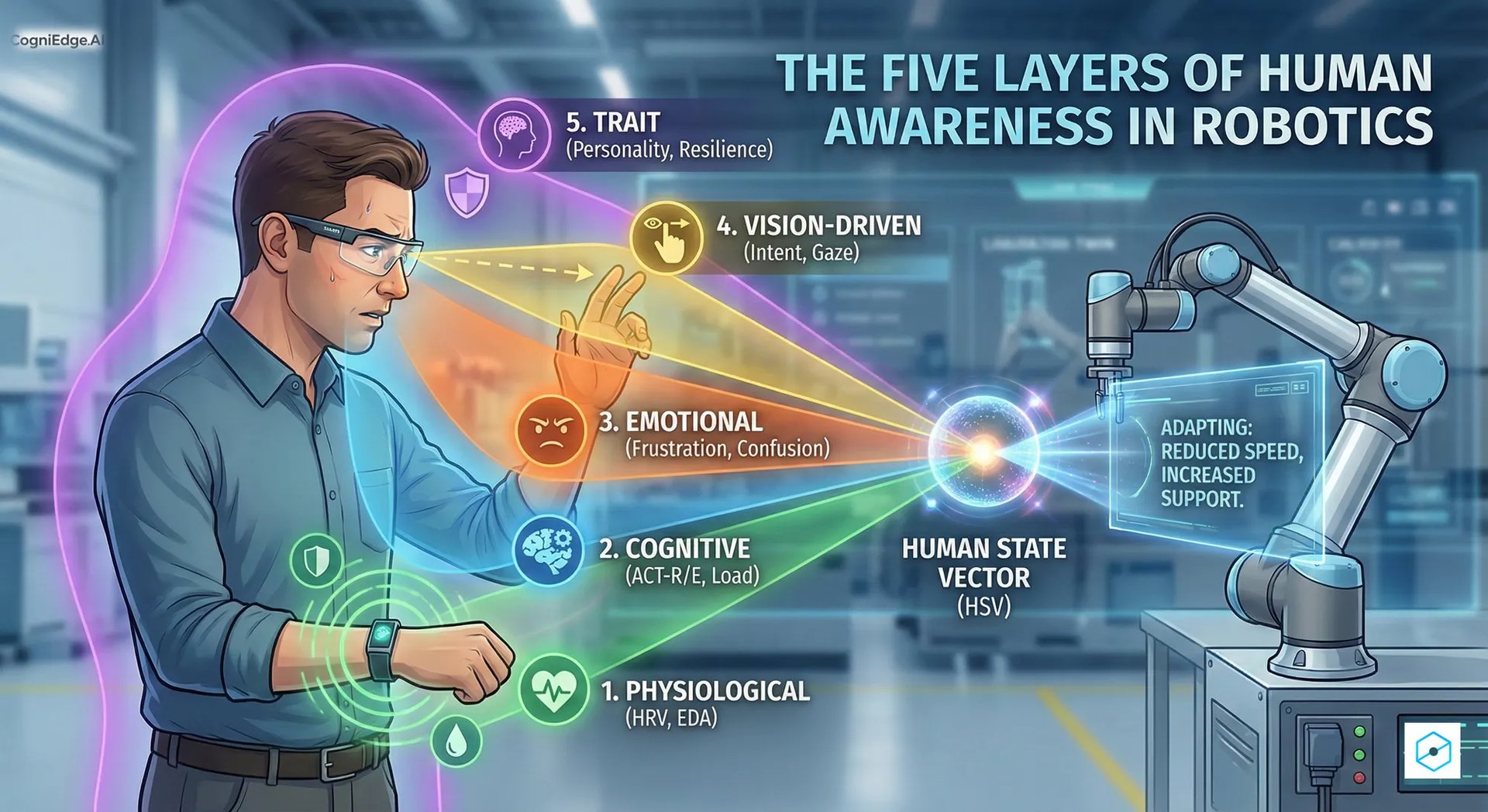
In collaborative scenarios, this human quality excels. An individual might briefly err in judgment but will swiftly adjust, informed by accumulated experience. Overly rigid robots, by comparison, halt or require external resets in similar situations. This is where frameworks like CEDR’s neuroadaptive elements shine, detecting subtle human cognitive states (like confusion or fatigue) and responding with considerate adjustments, such as reallocating responsibilities to maintain a seamless flow.
The CEDR Framework: An Architecture for Resilience
Rather than chasing perfection, CogniEdge’s CEDR framework reorients Physical AI toward an integrated, adaptive ecosystem that weaves resilience throughout its core. It achieves this by unifying key technologies at the edge:
Collaborative Sensing: Merges diverse inputs (vision, bio-signals like EEG, lidar) for a comprehensive awareness, allowing quick recalibration when signals vary.
Edge Computing: Supports immediate, localized decisions, enabling swift responses to emerging inconsistencies without crippling latency or external dependencies.
Digital Twins: Offer virtual environments for exploring “what-if” scenarios, refining approaches to potential disruptions in safe simulations before they happen in the real world.
Proactive HRC: Facilitates empathetic exchanges where robots can openly communicate adjustments (“I see an obstacle I don’t recognize”) and incorporate human guidance.
Bio-inspired Planning: Orchestrates group activities (human + cobot + humanoid), transforming individual variances into collective strengths for optimized, emergent outcomes.
A centralized “single pane of glass” interface unites these elements, providing clear human oversight of these ongoing dynamics and adaptations.
From Brittle to Robust: Adapting in the Real World
Physical AI systems operate in unpredictable environments. Demanding zero deviations leads to rigid robots that break down. Instead, building in graceful degradation, through real-time detection, recovery mechanisms, and adaptive tools like those in CEDR, allows a robot to identify an issue, readjust, and continue effectively. This echoes how experienced humans draw on past experiences to navigate challenges, empowering cobots to improvise alongside people in collaborative settings without fostering overreliance.
Learning from Mistakes: A New Kind of HRI
Misinterpretations are a natural part of real interactions. Viewing these as opportunities for productive growth changes everything in HRI. A robot, using proactive HRC, can highlight its own uncertainty (“Are you asking me to move this here?”) and seek human input. This transparency builds genuine trust: people engage with robots as relatable, improving partners rather than unreachable ideals. This approach also minimizes skill erosion and deepens empathy, as the system refines its responses based on shared corrections.
The Cultural and Ethical Case for Imperfection
Cultural backgrounds profoundly influence how imperfection is perceived. In societies that celebrate harmony with flaws, error-tolerant robots feel more natural and welcoming. Transparent protocols and simulation tools in CEDR allow for culturally sensitive handling of variations, preventing trust breakdowns. Ethically, openly addressing deviations avoids unclear responsibility in team scenarios (like coordinated emergency response) and helps mitigate inherited biases, leading to fairer and more durable partnerships.
Innovation Through Synergy, Not Supremacy
The true vision of Physical AI is human-AI complementarity. Humans bring subtle judgment and creativity shaped by real-world experience; robots contribute consistent observation and accuracy. Bio-inspired coordination and proactive HRC in CEDR turn deviations in group tasks, such as warehouse operations, into valuable data for ongoing optimization. This approach sparks true innovation by removing the fear of setbacks, encouraging bold explorations in collaborative environments.
Forging a Resilient, Human-Centered Future
The CEDR framework from CogniEdge illustrates that prioritizing resilience over rigid ideals delivers intuitive, dependable systems aligned with emerging trends in adaptive intelligence. In assembly lines or care settings, humans can guide strategic oversight while robots manage repetitive precision, with the combined team tackling intricate challenges. When focus shifts unexpectedly, the system fluidly redistributes roles, sustaining progress without interruption.
This approach invites leaders to reimagine operations with frameworks that honor human strengths.
By welcoming imperfection as a catalyst for resilience, Physical AI evolves into an empowering ally, elevating our collective capabilities in harmonious, adaptive ways. In this era of collaboration, our shared variances are not hurdles but the pathway to enduring, innovative synergy.